Opportunity Zones
The Opportunity Zone (OZ) program is a federal initiative designed to encourage economic development and job creation through long-term private investment in designated low-income urban and rural communities.
Program background
Originally enacted as part of the Tax Cuts and Jobs Act of 2017, the program provides federal tax incentives for taxpayers who reinvest realized capital gains into Qualified Opportunity Funds (QOF), which in turn invest in designated Opportunity Zones.
Under the recently enacted One Big Beautiful Bill Act (OBBBA) signed by President Trump—the Opportunity Zone program has been made permanent and modernized to support long-term and targeted investment. Investors may benefit from the deferral of capital gains and additional tax advantages tie
Opportunity Zones 2.0
The One, Big, Beautiful Bill Act (OBBBA) was signed into law on July 4, 2025, making the Opportunity Zone program permanent. Under the updated law, Opportunity Zones will be redesignated every 10 years, and several aspects of the program’s requirements and incentives have been revised.
As a result of these updated requirements, not all currently designated Opportunity Zones will qualify under the revised eligibility criteria. This places greater importance on the upcoming redesignation process as states identify priority areas for inclusion in the next round of designations.
Under federal guidance, governors are provided a window—beginning July 1, 2026—to submit Opportunity Zone nominations to the U.S. Department of the Treasury. This timeline shapes the state’s nomination process and requires timely coordination with local stakeholders to identify and advance priority census tracts.
In response to these changes, the South Carolina Department of Commerce (SC Commerce) has begun the process of supporting Governor McMaster in nominating up to 25% of South Carolina’s eligible census tracts for Opportunity Zone designation. Again, while some tracts designated under the existing program will be eligible for redesignation, others may not.
To ensure the state’s nominations reflect local priorities, SC Commerce will engage with local governments, economic development organizations, community leaders, and the public at large.
Submit a census tract for consideration
If you would like to submit a census tract for consideration as an Opportunity Zone, please complete the form below by June 15, 2026.
Changes Under OBBBA
The OBBBA introduces several updates to the Opportunity Zone program:
- Makes the Opportunity Zone program permanent and requires that OZs be redesignated every 10 years.
- Establishes new reporting requirements for Qualified Opportunity Funds and directs the U.S. Treasury to publish annual reports on Opportunity Zone investment activity and outcomes, increasing transparency around the program’s impact.
- Provides a new incentive structure, including a five-year rolling deferral beginning on the date of investment and a 10 percent step-up in basis for investments held for five years.
- Updates eligibility criteria by defining low-income communities as census tracts that meet either:
- A median family income below 70 percent of the applicable state or metropolitan median or
- A poverty rate of at least 20 percent and a median family income below 125 percent of the applicable median.
- Eliminates the “contiguous tracts” exception from the first iteration of the program.
- Updates eligibility criteria by defining low-income communities as census tracts that meet either:
- Enhances the incentive for investment in rural Opportunity Zones
- Defines a rural area as any area other than:
- A city or town with a population of greater than 50,000 and
- An urbanized area adjacent to a city or town with a population in excess of 50,000.
- Defines a rural area as any area other than:
NOTE: Review the IRS Notice 2025-50 for more information on the definition released by the U.S. Treasury.
- Provides a 30 percent step-up benefit for investments in a rural Opportunity Zone.
- Reduces the substantial improvement threshold for qualifying projects in rural Opportunity Zones from 100 to 50 percent.
Opportunity Zone Participation Overview
Opportunity Zones create a framework for businesses, communities and investors to work together to drive economic growth and unlock private capital.
*Some of the information below is subject to change pending future U.S. Treasury guidance.
For Businesses
To take advantage of the Qualified Opportunity Zone (QOZ) program, businesses must meet the following requirements.
For Communities
States and local communities can use Opportunity Zones to attract private investment without new public spending, catalyze redevelopment in distressed or underutilized areas, support job creation and tax base growth, and complement existing incentives to improve overall competitiveness. Communities should follow this process to attract investment.
For Investors
Investors do not need to live, work, or operate a business in an Opportunity Zone to invest in South Carolina. Review the criteria below to understand the requirements of participating through a Qualified Opportunity Fund (QOF).
May 21 | 10:00 am
Webinar: Opportunity Zone Program and Nomination Process
Learn more about updated eligibility requirements, program benefits and the process to recommend census tracts.
Timeline for South Carolina Opportunity Zone Selection
April–June 2026
Community Nomination Period
Objective: Collect nominations and input from local communities across South Carolina.
At the beginning of April, SC Commerce will provide local governments and economic development organizations with information about Opportunity Zones, a list of eligible census tracts and instructions for submitting nominations.
Communities will rank census tracts in their areas in order of preference and explain why each tract should be nominated by the Governor. Submissions will be due by June 15, 2026.
June–July 2026
Nomination Review and Recommendation
Objective: Evaluate nominations and develop final recommendations for Opportunity Zone designation.
Using community nominations and further research and analysis, SC Commerce will develop a recommended list of census tracts for nomination.
July 2026
Governor Submission
Objective: Submit final recommendations to the Governor.
By July 1, SC Commerce will submit the final list of recommended Opportunity Zone census tracts and supporting executive report to the Governor for final consideration.
Governor McMaster will submit final nominations of census tracts for Opportunity Zone designation to the U.S. Treasury.
January 2027
The new designated Opportunity Zones will go into effect.
How Opportunity Zones Work
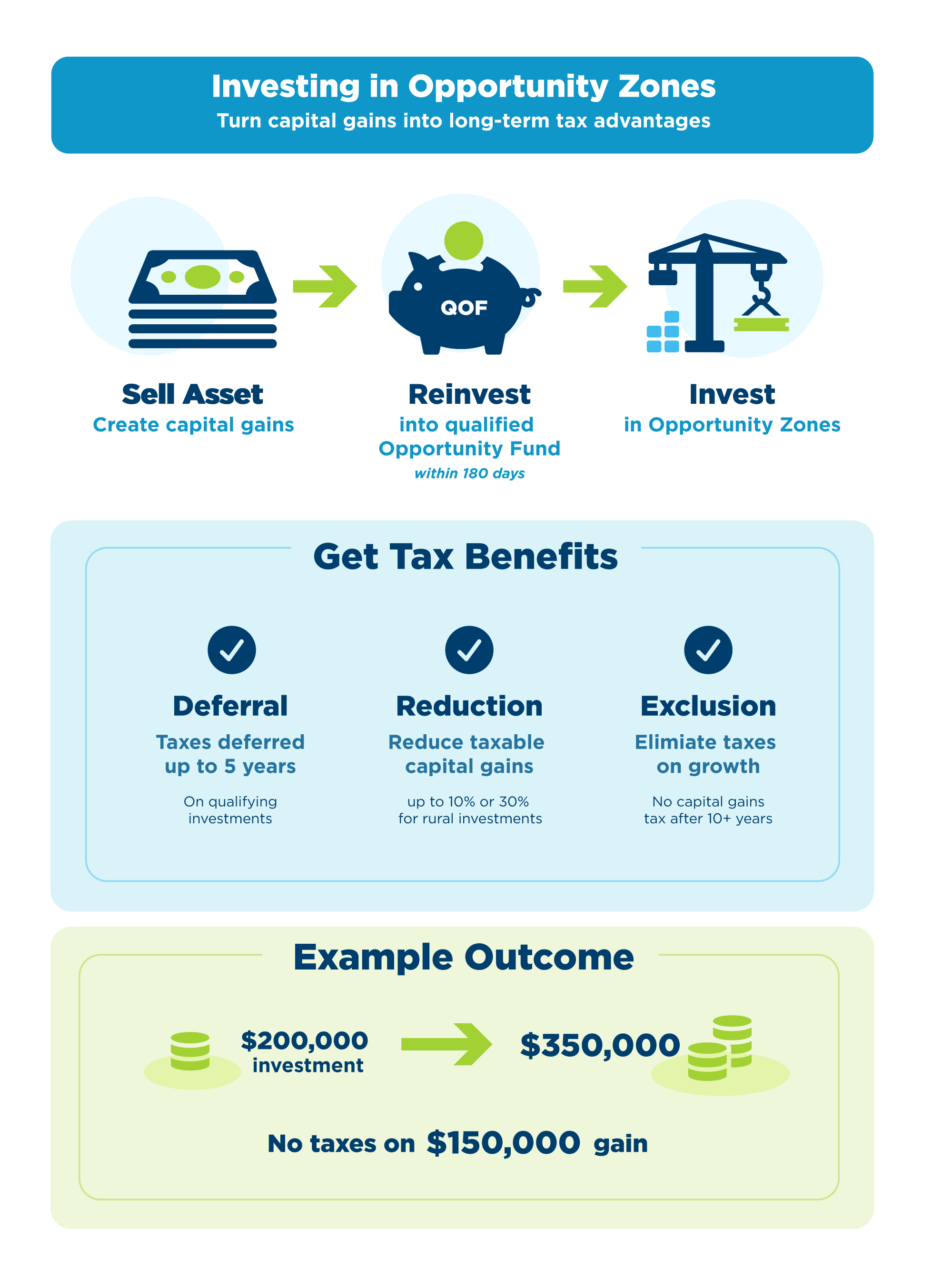
- Step 1: Create Capital Gains: An investor sells assets (stocks, real estate) and generates a capital gain.
- Step 2: Reinvest in Fund: Within 180 days, the investor places the gains into a Qualified Opportunity Fund (QOF).
- Step 3: Invest in Zones: The QOF invests in Qualified Opportunity Zone property, businesses, or real estate (e.g., affordable housing, business development).
- Step 4: Tax Benefits under Opportunity Zone 2.0:
- Deferral: For gains invested in QOF after December 31, 2026, taxes are deferred until 5 years after the investment in QOF.
- Reduction of Deferred Gains: The adjusted basis of any QOF investment held for at least 5 years is increased by an amount equal to 10% of the deferred gain, or 30% for investments made into rural QOF investments
- Exclusion (10+ years): A taxpayer who holds its QOF investment for at least 10 years may elect, on the sale or exchange of the QOF investment, to adjust the tax basis of the disposed investment to (1) the FMV on the date of sale, or (2) the FMV on the 30th anniversary of the investment date (for investments sold after 30 years)
South Carolina Opportunity Zones Interactive Map
The map below reflects Opportunity Zone designations approved in 2018 and does not represent current or future designations. Areas marked in blue represent current Opportunity Zones that were designated in 2018. When using the search tool, you may need to zoom out to determine whether a location falls within a highlighted zone.
This map reflects Opportunity Zone designations approved in 2018 and does not represent current or future designations.
* This address locator is provided as a service to help potential investors determine the likelihood that a particular address falls within an Opportunity Zone. It is not meant to provide a definitive judgement on the qualification of a particular address and should not be used as such. It is advised that all prospective participants in the Opportunity Zone program consult the County of record for a more detailed analysis of the parcel in question as well as evaluate the regulations put forth by the U.S. Department of the Treasury.
Download a PDF of the 2018 Opportunity Zone census tracts (not current designations).
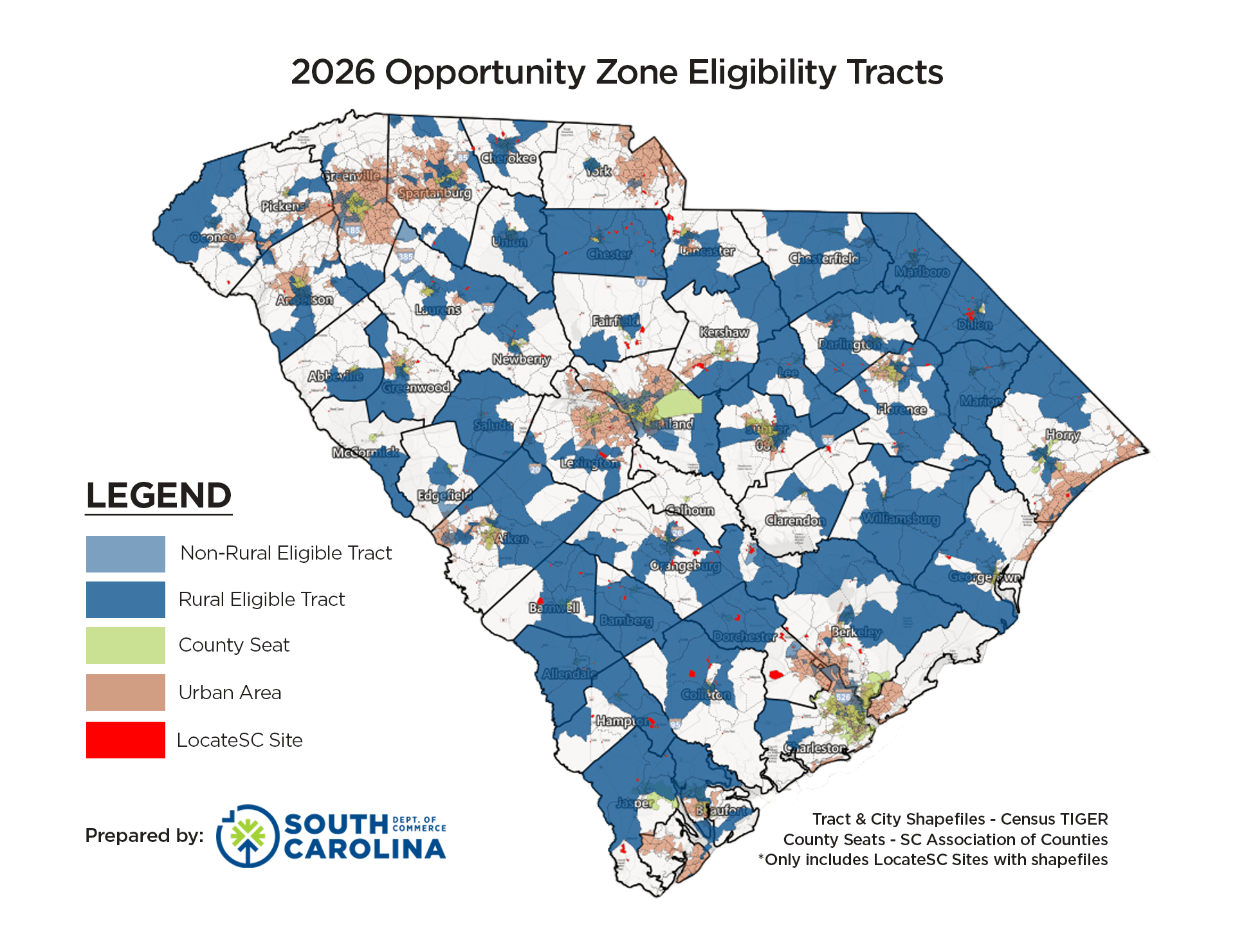
The map below shows census tracts eligible for consideration for Opportunity Zone designation as determined by the U.S. Treasury. See https://www.irs.gov/pub/irs-drop/rp-26-14.pdf. Please note that not all of these eligible tracts will be designated as Qualified Opportunity Zones. The Governor may only designate up to 25% of the eligible tracts.
Find incentives for your business
Download our Incentives Guide